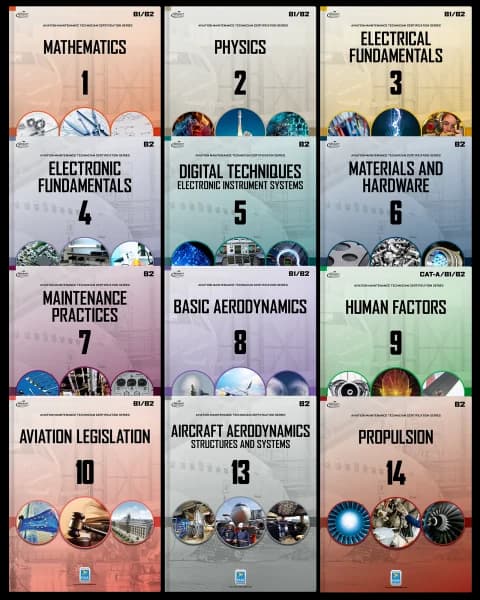
Everything a Category A1 candidate needs for the aeroplane turbine route, from Module 1 to the propeller module, in one purchase. The library bundles 12 volumes, each one written for the licence scope it serves, so there is no duplicated or out-of-category material.
Together the volumes cover 163 syllabus subjects of Regulation (EU) 2023/989, Part-66 Appendix I for Cat A1. One purchase gives you the whole reading list.
Plan your study by module: finish a volume, practise its competencies in the Quiz Engine, then sit the timed exam simulation. The Online Senior Instructor tracks which volumes to open next.
How it helps you pass the exam
Consistent structure from volume to volume, so you spend your hours learning rather than re-learning how to read the book.
A single, complete reading list for the whole route, mapped to the syllabus subject by subject.
Built for Category A1 candidates who want the whole syllabus in one library at a lower price than buying volume by volume.
163 syllabus subjects, each shown with the knowledge level examined for the licence scope of this product. Level 1 is familiarisation, Level 2 is general knowledge and Level 3 is detailed knowledge.
Show all 163 subjects
1.1ArithmeticL1
1.2(a)Algebra — Simple algebraic expressionsL1
1.3(b)Geometry — Graphical representationL2
2.1MatterL1
2.2.1Mechanics — StaticsL1
2.2.2Mechanics — KineticsL1
2.2.3(a)Mechanics — Dynamics: Mass, force and energyL1
2.2.3(b)Mechanics — Dynamics: Momentum and conservation of momentumL1
2.2.4(a)Mechanics — Fluid dynamics: Gravity and densityL2
2.2.4(b)Mechanics — Fluid dynamics: Viscosity; compressibility on fluids; static, dynamic, and total pressureL1
2.3(a)Thermodynamics — TemperatureL2
2.3(b)Thermodynamics — HeatL1
3.1Electron theoryL1
3.2Static electricity and conductionL1
3.3Electrical terminologyL1
3.4Generation of electricityL1
3.5Sources of DC electricityL1
3.6DC circuitsL1
3.13AC theoryL1
5.1Electronic instrument systemsL1
5.6(a)Basic computer structure — Computer terminology and technologyL1
5.11Electronic displaysL1
5.12Electrostatic sensitive devicesL1
5.15Typical electronic/digital aircraft systemsL1
6.1(a)Aircraft materials, ferrous — Alloy steels used in aircraftL1
11.4(a)Air conditioning and cabin pressurisation (ATA 21) — PressurisationL1
11.4(b)Air conditioning and cabin pressurisation (ATA 21) — Air supplyL1
11.4(c)Air conditioning and cabin pressurisation (ATA 21) — Air conditioningL1
11.4(d)Air conditioning and cabin pressurisation (ATA 21) — Safety and warning devicesL1
11.5.1Instruments/avionics systems — Instrument systems (ATA 31)L1
11.5.2Instruments/avionics systems — Avionics systems: fundamentals of system layouts and operation of Autoflight (ATA 22), Communications (ATA 23), Navigation systems (ATA 34)L1
11.6Electrical power (ATA 24)L1
11.7(a)Equipment and furnishings (ATA 25) — Emergency equipmentL2
11.7(b)Equipment and furnishings (ATA 25) — Cabin and cargo layoutL1
11.8(a)Fire protection (ATA 26) — Fire and smoke detection system and fire-extinguishing systemsL1
11.8(b)Fire protection (ATA 26) — Portable fire extinguisherL1
11.9(a)Flight controls (ATA 27) — Primary and secondary flight controlsL1
11.9(b)Flight controls (ATA 27) — Actuation and protectionL1
11.9(c)Flight controls (ATA 27) — System operationL1
11.9(d)Flight controls (ATA 27) — Balancing and riggingL1
11.10(a)Fuel systems (ATA 28, ATA 47) — Systems layoutL1
11.10(b)Fuel systems (ATA 28, ATA 47) — Fuel handlingL1
11.10(c)Fuel systems (ATA 28, ATA 47) — Indication and warningsL1
11.10(d)Fuel systems (ATA 28, ATA 47) — Special systemsL1
11.10(e)Fuel systems (ATA 28, ATA 47) — BalancingL1
11.11(a)Hydraulic power (ATA 29) — System descriptionL1
11.11(b)Hydraulic power (ATA 29) — System operation (1)L1
11.11(c)Hydraulic power (ATA 29) — System operation (2)L1
11.12(a)Ice and rain protection (ATA 30) — PrinciplesL1
11.12(b)Ice and rain protection (ATA 30) — De-icingL1
11.12(c)Ice and rain protection (ATA 30) — Anti-icingL1
11.12(d)Ice and rain protection (ATA 30) — WipersL1
11.12(e)Ice and rain protection (ATA 30) — Rain repellent systemsL1
11.13(a)Landing gear (ATA 32) — DescriptionL2
11.13(b)Landing gear (ATA 32) — System operationL2
11.19(a)Integrated modular avionics (ATA 42) — Overall system description and theoryL1
11.19(b)Integrated modular avionics (ATA 42) — Typical system layoutsL1
11.20Cabin systems (ATA 44)L1
11.21Information systems (ATA 46)L1
15.1FundamentalsL1
15.3InletL2
15.4CompressorsL1
15.5Combustion sectionL1
15.6Turbine sectionL2
15.7ExhaustL1
15.9Lubricants and fuelsL1
15.10Lubrication systemsL1
15.11Fuel systemsL1
15.12Air systemsL1
15.13Starting and ignition systemsL1
15.14Engine indication systemsL1
15.16Turboprop enginesL1
15.17Turboshaft enginesL1
15.18Auxiliary power units (APUs)L1
15.19Power plant installationL1
15.20Fire protection systemsL1
15.21Engine monitoring and ground operationL1
17.1FundamentalsL1
17.2Propeller constructionL1
17.3Propeller pitch controlL1
17.5Propeller ice protectionL1
17.6Propeller maintenanceL1
17.7Propeller storage and preservationL1
Detailed programme
M01 · Mathematics
1.1 Arithmetic
1.2 Algebra
1.3 Geometry
M02 · Physics
2.1 Matter
2.2 Mechanics
2.3 Thermodynamics
M03 · Electrical Fundamentals
3.1 Electron theory
3.2 Static electricity and conduction
3.3 Electrical terminology
3.4 Generation of electricity
3.5 Sources of DC electricity
3.6 DC circuits
M05 · Digital Techniques and Electronic Instrument Systems
5.1 Electronic instrument systems
5.6 Basic computer structure
5.11 Electronic displays
5.12 Electrostatic sensitive devices
5.15 Typical electronic/digital aircraft systems
M06 · Materials and Hardware
6.1 Aircraft materials, ferrous
6.2 Aircraft materials, non-ferrous
6.3 Composite and non-metallic other than wood and fabric
6.4 Corrosion
6.5 Fasteners
6.6 Pipes and unions
M07 · Maintenance Practices
7.1 Safety precautions
7.2 Workshop practices
7.3 Tools
7.5 Engineering drawings, diagrams and standards
7.6 Fits and clearances
7.7 Electrical wiring interconnection system (EWIS)
M08 · Basic Aerodynamics
8.1 Physics of the atmosphere
8.2 Aerodynamics
8.3 Theory of flight
8.4 High-speed airflow
8.5 Flight stability and dynamics
M09 · Human Factors
9.1 General
9.2 Human performance and limitations
9.3 Social psychology
9.4 Factors that affect performance
9.5 Physical environment
9.6 Tasks
M10 · Aviation Legislation
10.1 Regulatory framework
10.2 Certifying staff
10.3 Approved maintenance organisations
10.5 Air operations
10.6 Certification of aircraft, parts, and appliances
10.7 Continuing airworthiness
M11 · Turbine Aeroplane Aerodynamics, Structures and Systems
11.1 Theory of flight
11.2 Airframe structures (ATA 51)
11.3 Fuselage, doors, windows (ATA 52/53/56)
11.4 Air conditioning and cabin pressurisation (ATA 21)
11.5 Instruments/avionics systems
11.6 Electrical power (ATA 24)
M15 · Gas Turbine Engine
15.1 Fundamentals
15.3 Inlet
15.4 Compressors
15.5 Combustion section
15.6 Turbine section
15.7 Exhaust
M17 · Propeller
17.1 Fundamentals
17.2 Propeller construction
17.3 Propeller pitch control
17.5 Propeller ice protection
17.6 Propeller maintenance
17.7 Propeller storage and preservation
Technical specifications and licence eligibility
Volumes
12
Modules covered
12
Licence scope
A1
Syllabus subjects
163
Formats
eBook
Regulatory basis
Regulation (EU) 2023/989, Part-66 Appendix I
Delivery
Confirmed at checkout
Designed for Category A1 candidates who want the whole syllabus in one library at a lower price than buying volume by volume. This manual supports your study and exam preparation. It does not replace approved Part-147 training or the examination set by your competent authority.
EASAPART66.EU is an independent learning platform. Study manuals and courses support exam preparation and familiarisation; they do not replace approved Part-147 training, a type-rating course or the examination set by your competent authority. Prices are in US dollars; other currencies are indicative.